A Nerve Must Look After Itself
A Common but Incomplete Picture
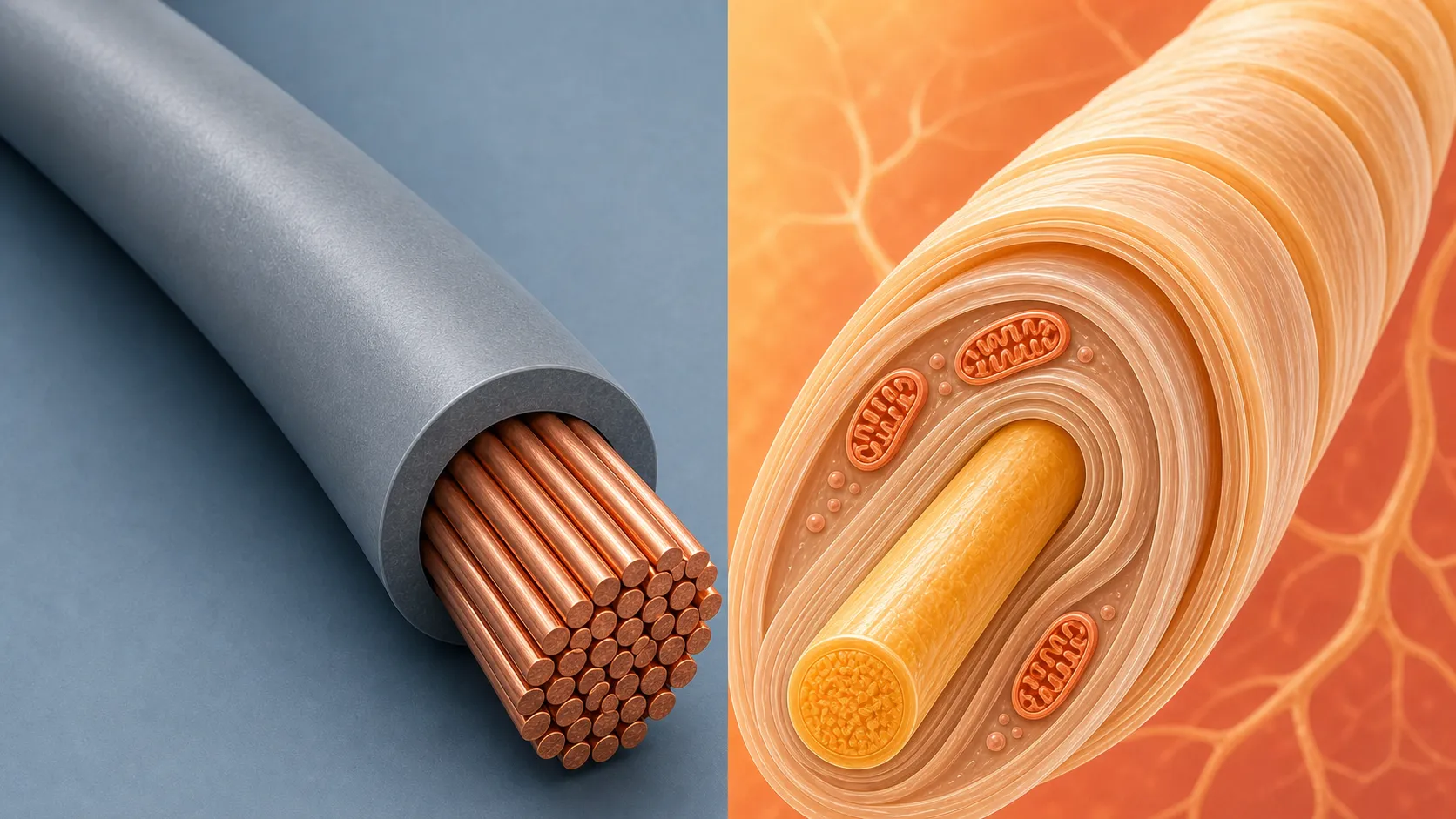
Most people picture a nerve as something like an electrical wire — a cable carrying signals between the brain, the spinal cord, and the rest of the body. When the wire is damaged, the signal weakens, distorts, or drops out, and symptoms appear.
That picture isn’t wrong. But it leaves out the part that matters most for understanding why nerve conditions develop, why they persist, and what can be done about them.
Because a nerve is not a wire. A wire has no needs of its own. It doesn’t have to be maintained from the inside, doesn’t repair itself, doesn’t do anything at all to keep working — it simply sits there and carries current until something breaks it.
A nerve is alive. And being alive changes everything that follows.
Being Alive Means Having Needs
A nerve is living tissue — Cells that are working every moment to keep themselves in good repair: such as building and replacing their own materials, managing waste, holding their structure together, meeting the constant running costs of staying alive.
This is not a small background task. It is the most fundamental thing a nerve does. And this is the work that has to be happening for the nerve to be a nerve at all.
And here is the part the wire model quietly takes away: because a nerve is alive, its condition is not simply fixed in place. A wire’s situation only ever gets worse — things happen to it, and none of them can be undone. A living nerve is different. It is actively keeping itself going, and the conditions it depends on to do that can be made better or worse. It responds either way.
It Must Keep Itself Alive to Do Anything at All
Here is the idea at the heart of this page — and it is a biological fact, not a figure of speech.
In order for a nerve to do its job for the body — to carry the signals that let you feel and move — it has to be keeping itself alive. This isn’t its first or second or third task in time; it is the condition of having any tasks at all. A dead nerve does nothing. So staying alive is the one demand a nerve can never set aside.
A nerve that is fully maintained, properly resourced, does its outward work cleanly and without strain — the signalling you never have to think about is what a well-supplied nerve looks like from the outside. But its upkeep and its survival are not two separate jobs; they are the same self-care along a single spectrum. Like anyone who lets their own health slide to get through a demanding stretch, a nerve can leave off that upkeep for a while to meet more immediately pressing demands — though not indefinitely. Push the neglect far enough and it reaches a point where going further would threaten survival itself, and there the deferring has to stop.
This is easy to miss, because in a healthy nerve all of it — staying alive and in good repair, doing the outward work — happens simultaneously, and none of it shows. But where it really shows up is when resources run short, because then a nerve can no longer do everything, and what it holds onto and what it lets slide are not the same thing.
When There Isn’t Enough to Go Around
On the previous page we described nerve function as a balance held between two forces — one drawing the nerve’s resources down, one restoring them — with a reserve that absorbs ordinary knocks. That reserve is not a store of something set aside. It is the nerve’s own good condition — a nerve in sound repair can take a knock and carry on, where a worn one can’t.
When a nerve is in good condition, there is no conflict: the nerve maintains itself and does its job, easily. But when the conditions it depends on come under strain — such as poor circulation, metabolic stress, ongoing compression or injury — the resources available start to fall short of everything the nerve is being asked to do. And then, like any living system that is stretched too thin, it has to make hard choices about what it can still cover.
By the time symptoms appear, a nerve is not in sound repair. It is not working from a position of strength; it is working at a reduced capacity, with less energy, fewer materials, and less ability to repair itself than it had — and every choice it makes is a choice about what that reduced capacity will still stretch to cover.
These are not choices made lightly. They are the kind where every option costs something. And the nerve tends to make the same choice a living thing under strain usually makes: it keeps doing the urgent outward work — the signalling your body needs from it right now — and quietly lets its own slower, less immediately urgent upkeep fall behind. It runs a deficit on itself to keep serving you. In other words, it keeps serving the needs outside of itself at its own expense.
For a while, it can do that. That is what good condition allows. But there is a reason the shortfall tends not to correct itself: the body’s need for the nerve never lets up. A living body requires its nerves continuously — waking and sleeping, in motion and at rest. There is no quiet period in which the nerve is off duty and free to catch up on itself. And the conditions straining it keep bearing down, day after day. So the nerve keeps deferring its own maintenance to meet a demand that never pauses, and its own condition slides further while it does. A nerve in this state is drawn down — its still working, still doing its job, but doing it in worse repair than it should be, and with less to draw on each time there is a knock, or something asks more of it.
This is the quiet, important truth beneath a nerve condition. Not a wire sitting broken, waiting to be replaced. A living system doing everything it can, making difficult choices under sustained strain, still serving the body it belongs to — and carrying the cost of what it has had to set aside.
Where This Leaves You
The nerve is deferring its own care because of the conditions it is living in — and those conditions are not fixed. They are the part of this picture that can change. A nerve running behind on its self-repair is not a nerve that has failed; it is a nerve waiting for the strain to ease enough that it can catch up on its own upkeep. Improve the conditions it depends on, and you give it exactly that — the room to put resources back into maintaining itself, and to return to better repair over time.
That is what makes the next question the practical one. If a nerve has needs that must fulfilled in order to function, firstly what exactly are those needs, and following on from that why can’t it always get those needs met — are what actually shape whether function holds, declines, or recovers.
And this is where the symptoms come from. The pain. The sensation that has become unreliable — burning, tingling, numbness, a foot that doesn’t report back the way it used to. The weakness, the grip that is less certain than it was, the fatigue that arrives sooner than it should. These are the things people bring to an appointment, and they are usually where the conversation stays. But each of them is a downstream event. They are what a drawn-down nerve looks like from outside the nerve — which is where you live. The shortfall is the difference between what the nerve needs to function and do its work well and what it actually has — which means the place to look is not the symptom itself, but what is missing underneath it.
So what are those needs? And why, so often, do they go unmet?
Where to Go Next
Next Step (Follow the Path)
→ What the Nerve Needs, and Why It Struggles — Needs and struggles reveal a lot about your symptoms.