Ways That Nerve Function Changes Over Time
Nerve Function: A Balance That Can Tip Either Way
On the previous page we introduced a simple but important idea: the quality of nerve function is not fixed — and it is not simply on or off. It’s easy to assume a nerve either works or it doesn’t, and that once something goes wrong there is nothing to do but wait and see.
In reality, its quality is held in a balance between two ongoing processes — one that draws down the nerve’s resources, and one that restores and renews them. In a healthy nerve the two run in balance, with enough reserve to take an ordinary knock (stressor) and recover.
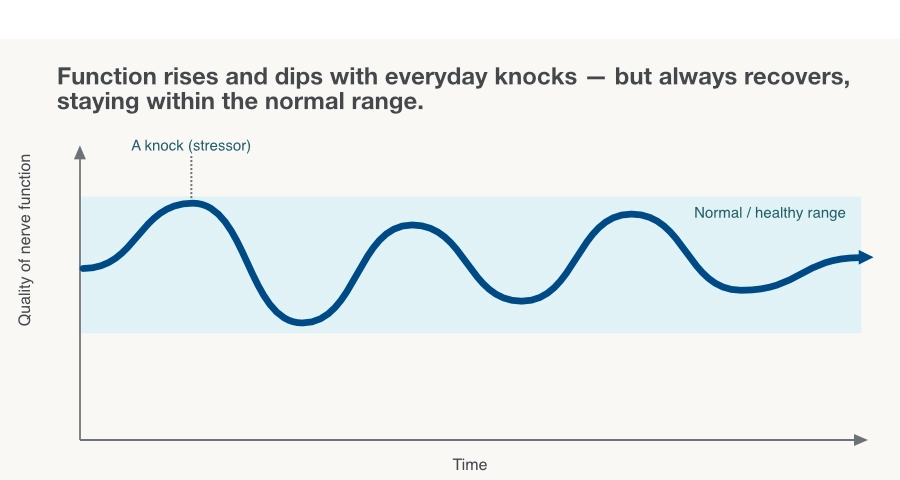
When the balance tips too far for too long, function declines — depletion and degradation outpacing restoration and regeneration — and as reserve wears thin, smaller stresses are enough to tip it further. But the converse is also true: when restoration outpaces depletion, function improves. And when that direction of improving holds long enough, reserve is gradually rebuilt — until the everyday knocks that once tipped the balance are absorbed instead. Sustained over time, that is what recovery is made of.
These shifts rarely show in a single day. Over weeks and months, though, a clear direction of change emerges — one that can be pictured as a trend over time.
The Patterns in Practice
Once the quality of nerve function drops below its normal, healthy range — in other words, once the nerve is impaired and no longer working as it should — it tends to follow one of these patterns. Each is a direction relative to normal: improving is movement back toward it, declining is movement further from it, and “holding the line” is preserving the function that remains.
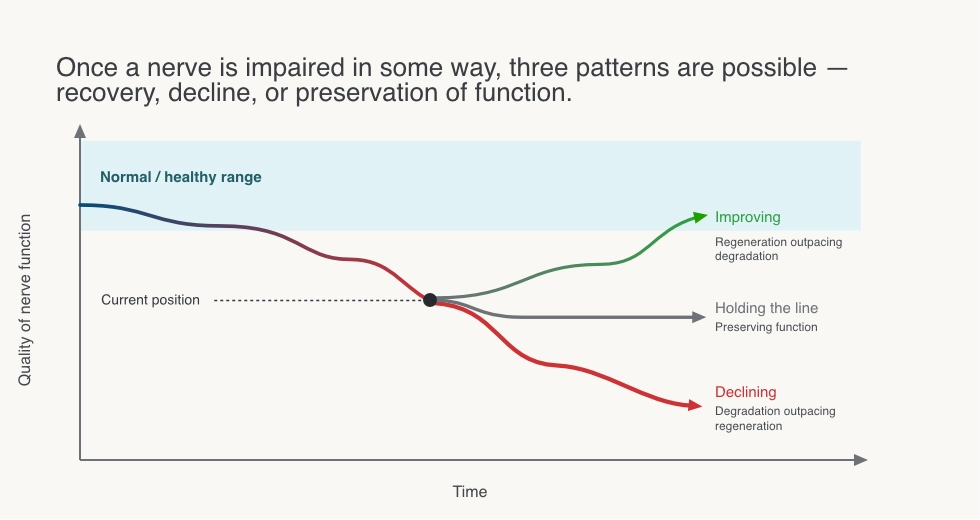
None of these trajectories is fixed. They are shaped by the biological conditions surrounding the nerve — which means they can change. Reading through them, you may recognize the one you are currently in — or one you have experienced before.
Declining
When function is declining, symptoms or limitations are expanding — gradually, or sometimes in noticeable steps.
Indications may include:
- Pain becoming more frequent or more intense
- Numbness spreading to new areas or deepening where it was already present
- Sensitivity increasing — to touch, temperature, or pressure
- Stamina decreasing, or fatigue arriving more quickly than it used to
- Recovery taking longer after physical or mental activity
- Reduced tolerance for activities — physical, mental, or social — that were previously manageable
- Strength gradually declining
For many people, recognizing this pattern is uncomfortable. But seeing it clearly is the first step toward understanding what may be driving it — and what might help shift it.
Improving
When function is improving, the nervous system is regaining its ability to maintain, adapt, regulate, and repair more effectively.
Indications may include:
- Pain episodes becoming less intense, less frequent, or easier to manage
- Sensation becoming clearer, more consistent, or more normal
- Recovery occurring more easily after activity
- Strength improving
- Stamina improving
- Greater tolerance for physical, mental, or social activity than before
- Sleep becoming deeper or more restorative
These changes often appear gradually and perhaps inconsistently at first. A slightly better week followed by a harder one. An improvement that seems to hold, then wavers. This is normal. Changes in function can happen unevenly over time, not in a perfectly straight line.
Holding the Line: Preserving Function
Between the two directions sits a third pattern that matters more than it first sounds. Sometimes function has been declining for months or years, and then that decline slows or stops. Nothing is being regained yet — but nothing more is being lost. The balance between depletion and restoration has been brought closer even — holding, for now, at a lower level than normal.
This is worth naming on its own, because holding the line, preserving function is a real achievement. If someone has been losing function steadily, arresting that decline — preserving what remains — can be the outcome that’s far more significant than it may at first sound. Keeping any amount of something is worlds apart from losing all of it. Preserving what remains also protects the reserve you still have — the buffer that lets a nerve absorb stress without losing more ground.
Indications may include:
- Symptoms fluctuate from day to day but are no longer spreading
- Pain episodes level off in frequency or intensity rather than continuing to intensify
- Function becomes more predictable — fewer unexpected bad days
- Activity tolerance stops declining
- Recovery patterns settle into something more consistent
On the graph, this is the line that falls and then levels off: decline arrested, function preserved.
Recognizing Functional Trends
Individual days are unreliable guides. A difficult day does not necessarily mean the condition is declining. A good day does not necessarily mean recovery has arrived.
Patterns become visible gradually, across weeks and months. Through the ups and downs of daily experience, a larger trend begins to emerge.
Some questions that help:
- Are flare-ups happening more often than they were six months ago, or less?
- Is recovery after activity getting easier or harder than it was last month, or last year?
- Are there things you can do now that you could not before — or things that used to feel easy that have become difficult?
- Does the overall pattern of the last few months suggest that function is declining, holding the line, or improving?
These changes rarely happen overnight. They shift as the conditions affecting nerve self-recovery change over time. Learning to recognize them — in your own body and your own daily experience — is one of the most useful things you can do. This resource is designed to help with exactly that.
The Key Insight
What matters is how the nerve and the conditions it depends on are holding up together — and learning to recognize, support, and influence them is one of the central aims of this resource.
But to understand why those conditions matter so much — why the balance tips the way it does at all — it helps to look more closely at what a nerve actually is.
It’s less like a wire than most people imagine.
Where to Go Next
Next Step (Follow the Path)
→ A Nerve Must Look After Itself— It has to, and what happens when it can’t.